

Head-to-Toe Assessment Script
Video Script on Head-to-Toe Assessment (COPD Exacerbation)
Time: 12-14 minutes
Patient: "Mr. Davis" (Volunteer), 68 years old with a history of smoking, presents with dyspnea and fatigue.
Introduction (1 min)
Good morning to you, Mr. Davis. My name is Tom, and I will be responsible for a thorough assessment to check for the cause of your breathing issue. It seems that you have been experiencing a lot of tiredness and breathing difficulties for a few days, which fits with your background of having COPD. I want to let you know that this exam is very important for discovering your body’s condition and deciding what action should be taken next. I will examine each body system systematically, starting at your head and going down, and I will describe my steps and the reasons for them. When I say ‘auscultation’ or ‘percussion’, I mean that I am listening with my stethoscope or tapping, but I will clearly explain them as we proceed. You are always encouraged to mention or ask about anything that bothers you or that you are unsure about at any time. Understanding you and your comfort mean the most to me. First, let us go over the symptoms that you are experiencing at the moment.
Comprehensive Physical Assessment (5-6 min)
General Survey
The first step is for me to look at your entire approach and how much effort you put in. You are hunching forward with your hands on your knees and breathing by using your neck and shoulders, which are signs of trouble breathing. Your skin has a light and slightly grayish look, which suggests that not enough oxygen reaches your blood. Due to inflammation in the airways, your lungs do not expand completely, so these mechanisms take over (Carlin, 2023).
Vital Signs
I am reviewing all your vital signs. According to the reading, your blood pressure is 142/86, which is slightly above normal. The pulse is found to be 110 BPM, which means the heart increases its pumping to compensate for the lack of sufficient oxygen. The level of oxygen saturation found in the patient’s room air is 88%, which proves hypoxia. Because this is not greater than 94%, it clearly shows the person has a major impairment. I will give supplemental oxygen to the patient right away.
Head/Neck
I am touching your trachea in the middle, which is fine. Now you need to assess the jugular veins at an angle of 45 degrees. A slight dilatation (JVD) above the clavicle indicates that the person’s central venous pressure is high. This might mean the right heart is under strain because of chronic lung disease.
Chest/Lungs
I notice that you have a barrel-shaped chest from prolonged air in the lungs, which is a common feature of COPD during inspection.
Extremities
The capillary refill time is less than 2 seconds, so there is good blood flow to the area. There are no signs of pedal edema, showing that right heart failure is not acute. Still, I observe subtle blueness in your nails and lips, which is an indicator of less oxygen in the tissues. The angle of your nails (clubbing) proves to be greater than 180°, an indication of lasting COPD.
Diagnosis & Findings (2 min)
ME: COPD may be the reason behind your low oxygen, the noisy breathing you hear and how hard it is for you to breathe. Inflammation and narrowing of the airways in your lungs are the reasons you have trouble blowing air away (Voulgareli et al., 2025). Working hard exercises the body, thereby making it get exhausted.
Patient (Volunteer): Let me ask if it is only a cold that you have?
ME: "Correct. Chances are that you have suffered lung damage from being a smoker. We should handle this urgently to stop the condition from worsening.
Pharmacological Needs (2 min)
The first action will be to give you medication that opens your air passages.
Albuterol inhaler: The Logic for quick relief is to contract the airway muscles and make breathing easier.
Steroids (Prednisone): Lower the inflammation in the lungs.
Key Considerations: Because you are taking steroids, we will carefully watch your blood pressure, since it may go up due to hypertension.
Important: After inhaling a medicine, make it a habit to clean your mouth to stay safe from oral thrush. Do not smoke, because it can further damage COPD.
Also Read Tobacco Regulation in the US
Pathophysiology (1 min)
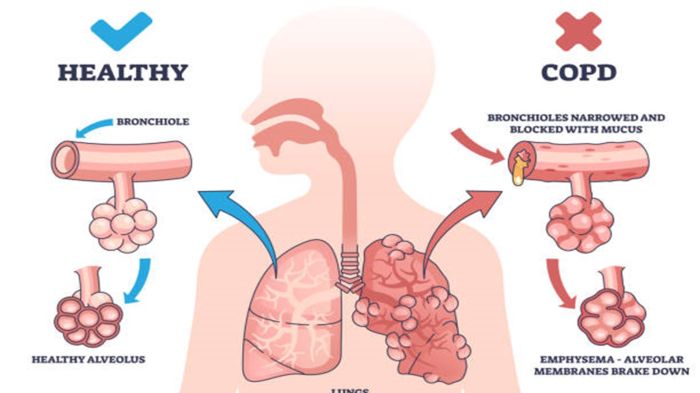
From the image above, “The disease leads to harming your lungs’ air sacs. If a sponge is worn out, it does not bounce back well and cannot release air well enough. Mucus collects in the throat, which results in both coughing and matters like infections. If nothing is done for the condition, a person finds it increasingly difficult to breathe, and even simple activities become tiring”(World Health Organisation, 2024).
Care Priorities & Clinical Reasoning (2 min)
Since the exam shows certain findings and COPD works a certain way, our goals are as follows:
Improve Oxygenation: Try to provide small amounts of supplemental oxygen, as giving a lot could damage COPD patients. The goal for your SpO₂ should be between 90 and 92%.
Prevent Complications: We’ll give you breathing exercises that can lower the chance of pneumonia.
Medication Adherence: Proper use of an inhaler matters a lot. I will explain the right methods step by step.
Evidence: It is stated in the guidelines that this method can reduce the rate of patients returning to the hospital by 30 percent.
Closing & Patient Education (1 min)
ME: We are going to give you another oxygen check soon. Do you have any additional questions?"
Patient: When is the pain anticipated to go away?
ME: If you receive treatment, you should do better in 2-3 days. Pulmonary rehab is part of the process to maintain your strength for a long period. I appreciate your help very much!
References
Carlin, B. W. (2023). Exacerbations of COPD. Respiratory Care, 68(7), 961–972. https://doi.org/10.4187/respcare.10782
Voulgareli, I., Antonogiannaki, E.-M., Bartziokas, K., Zaneli, S., Bakakos, P., Loukides, S., & Papaioannou, A. I. (2025). Early Identification of Exacerbations in Patients with Chronic Obstructive Pulmonary Disease (COPD). Journal of Clinical Medicine, 14(2), 397–397. https://doi.org/10.3390/jcm14020397
World Health Organisation. (2024, November 6). Chronic obstructive pulmonary disease (COPD). World Health Organisation. https://www.who.int/news-room/fact-sheets/detail/chronic-obstructive-pulmonary-disease-(copd)