


Mastering clinical assignments is key for nursing and healthcare students worldwide. These projects check if you can use medical theory in real patient situations. Learning to analyze data and case scenarios well can really help improve grades in your nursing studies.
Many students get lost in the details of patient care documents. But, with the right tips and nursing case support, you can change your approach. A clear method helps show your clinical thinking and professional skills to teachers.
This post offers vital nursing homework guidance to make your work easier and stay enlightened. It is advisable to focus on clear, evidence-based analysis to feel more confident.
Let's see how these strategies can boost your performance and help your future in healthcare assignments.
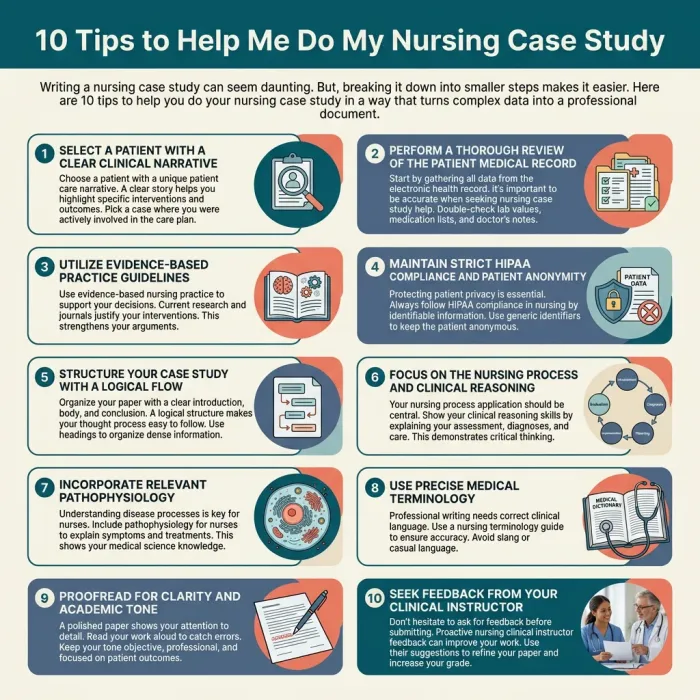
10 Tips to help me do my nursing case study
Writing a nursing case study can seem daunting. But, breaking it down into smaller steps makes it easier. Here are 10 tips to help you do your nursing case study in a way that turns complex data into a professional document.
Select a patient with a clear clinical narrative
Choose a patient with a unique patient care narrative. A clear story helps you highlight specific interventions and outcomes. Pick a case where you were actively involved in the care plan.
Perform a thorough review of the patient medical record
Start by gathering all data from the electronic health record. It's important to be accurate when seeking nursing case study help. Double-check lab values, medication lists, and doctor's notes.
Utilize evidence-based practice guidelines
Use evidence-based nursing practice and data from reliable nursing sources to support your decisions. Current research and journals justify interventions and their applications in practice, helping strengthen your arguments.
Maintain strict HIPAA compliance and patient anonymity
Protecting patient privacy is essential. Always follow HIPAA guidelines in nursing by removing identifiable information. Use generic identifiers to keep the patient anonymous.
Structure your case study with a logical flow
Organize your paper with a clear introduction, body, and conclusion. A logical structure makes your thought process easy to follow. Use headings to organize dense information.
Focus on the nursing process and clinical reasoning
Your nursing process application should be central. Show your clinical reasoning skills by explaining your assessment, diagnoses, and care. This demonstrates critical thinking.
Incorporate relevant pathophysiology
Understanding disease processes is key for nurses. Include pathophysiology for nurses to explain symptoms and treatments. This shows your medical science knowledge.
Use precise medical terminology
Professional writing needs correct clinical language. Use a nursing terminology guide to ensure accuracy. Avoid slang or casual language.
Proofread for clarity and academic tone
A polished paper shows your attention to detail. Read your work aloud to catch errors. Keep your tone objective, professional, and focused on patient outcomes.
Seek feedback from your clinical instructor
Don't hesitate to ask for feedback before submitting. Proactive nursing clinical instructor feedback can improve your work. Use their suggestions to refine your paper and increase your grade.
Strategies for academic excellence in nursing documentation
To excel in nursing, you need to link what you learn in class to real-world hospital settings. Mastering nursing documentation tips ensures your patient records are precise and professional. These skills are key for your success as a nursing student.
Connecting theory to bedside practice
The best students apply evidence-based nursing practice in every nursing case scenarios or patient interaction. When you see a diagnosis in a textbook, look for it in real patients. This connection strengthens your knowledge and improves patient care.
Always check your actions against hospital protocols and research. This keeps your care safe and effective. It also shows your instructors that you're thinking deeply.
Developing critical thinking skills through reflection
Reflective practice sharpens your clinical reasoning skills. After each shift, write down what worked and what didn't. This habit boosts your critical thinking in nursing by making you think about your decisions.
Think about how your actions helped the patient. If you find knowledge gaps, research them right away. This approach makes every clinical experience a learning chance.
Managing time effectively during clinical rotations
Good clinical rotation advice focuses on nursing student time management. You must prioritize tasks based on patient needs. Use a worksheet to keep track of important tasks.
If you're feeling overwhelmed, ask your preceptor for help. Good time management lets you care for patients better while keeping stress low. Handling these demands well is vital for your growth.
Strategy | Primary Benefit | Implementation Tip |
Reflective Journaling | Improved clinical reasoning | Write entries immediately after shifts |
Prioritization Matrix | Better time management | Rank tasks by patient stability |
Evidence Review | Stronger academic foundation | Use peer-reviewed nursing journals |
Active Documentation | Clearer patient records | Use concise, objective language |
Elevating your clinical writing for future success
Mastering clinical documentation is key to your career goals. The following are ways to enhance your skills through case study writing:
Use every case study writing task to improve your professional skills. Regular practice will make you perfect.
Practice advanced writing techniques to sharpen skills in clinical writing, boost your grades, and prepare to work in highly demanding professional environments
See each assignment as a chance to grow. Using these tips keeps you competitive. Stay dedicated to these standards for success.
Share your progress with peers to generate advanced knowledge and encourage growth in nursing practice.
Apply these strategies to your next project now. Your hard work today will help you write nursing documents that exceed expectations and thrive in real-practice settings.
Frequently Asked Questions
How can I effectively implement the 10 Tips to help me do my nursing case study to see real results?
To boost your nursing grades, start by picking a patient with a strong story. Follow our 10 Tips, like reviewing medical records and using evidence-based nursing. This creates a detailed analysis that shows your critical thinking skills.
Being consistent is key. Use these steps for every assignment to make excellence a habit.
Why is HIPAA compliance so important when I am writing a nursing case study?
HIPAA compliance is a must in U.S. healthcare. It keeps patient info safe and shows your professionalism. It's about protecting patients and showing you're ready for advanced nursing writing.
What is the most effective way to incorporate the nursing process into my clinical writing?
To highlight your clinical reasoning, outline the nursing process steps. Explain why you chose certain interventions, backed by pathophysiology. This shows you can apply textbook knowledge to real-world practice.
How can I improve my nursing student time management while handling heavy clinical rotations?
Managing time is tough for students. Use smart study strategies, like breaking tasks after your shift, starting assignments early, and breaking complex work into manageable tasks.
This prevents burnout and gives you time to focus on school work.
How does seeking nursing clinical instructor feedback help my long-term career?
Seeking feedback from instructors is key for growth. It helps you improve your writing and communication. This prepares you for professional standards and future success as a nurse leader.
Can you suggest a way to ensure my medical terminology is accurate and professional?
Use a trusted nursing terminology guide or resources from the National Library of Medicine. Correct terminology shows your attention to detail. It's vital for advanced nursing writing and professional success.