


Paragraph Starters: Words to Start Paragraphs in Nursing Essays
Nursing students often struggle to open paragraphs with confidence, clarity, and a natural academic tone. A weak opening line can make even strong evidence feel disconnected from the paragraph before it. This guide breaks down proven paragraph starters, shows real examples, and offers practical tips for stronger nursing essays.
Writing about patient care, ethics, or clinical procedures demands precision from the very first word of every paragraph. Paragraph starters act as small signals that guide readers through complex nursing arguments without confusion. Once you master these tools, your essays will read as more polished, logical, and persuasive to any grader.
This nursing homework resource covers definitions, categories, a full list of sixty usable phrases, and real writing examples. It also walks through common mistakes, practical tips, and emerging trends shaping nursing academic writing today. By the end, you should feel equipped to open every paragraph with clarity and purpose.
What Are Paragraph Starters, Exactly?
Paragraph starters are short words or phrases placed at the beginning of a paragraph to guide the reader. They signal whether a new idea is being added, contrasted, explained, or concluded within the essay. In nursing writing, these words often introduce evidence, clinical reasoning, or a shift toward patient outcomes.
A good starter does more than begin a sentence grammatically within an academic paper. It tells the reader exactly how this paragraph connects to the argument built in earlier paragraphs. Without this signal, even accurate nursing content can feel like a disconnected list of separate facts.
Consider the difference between a paragraph that simply begins with a fact and one that opens with context. "Nurses face high burnout rates" reads flatly compared to "Consequently, nurses face high burnout rates." The second version instantly tells readers this paragraph builds on a cause discussed just before it.
Why These Words Matter in Nursing Writing
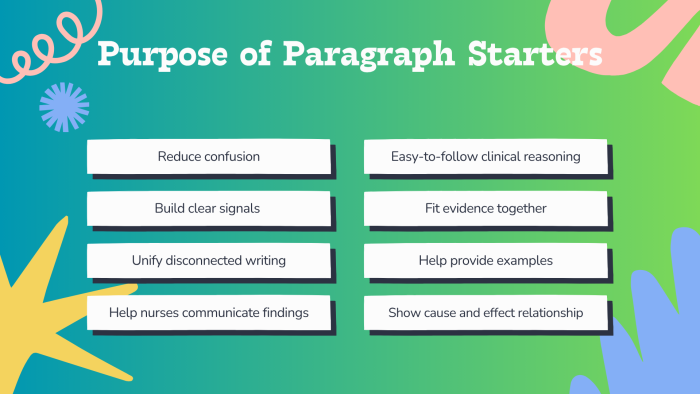
Nursing essays often combine clinical data, ethical reasoning, and patient-centered arguments within a single paper. Readers need clear signals to follow how each piece of evidence supports the central thesis statement. Strong paragraph starters reduce confusion and help instructors follow your clinical reasoning without extra effort.
Academic writing centers consistently emphasize that transitions carry real weight in scholarly work, not just style. According to Purdue University's detailed guide to academic transitions, transitions turn disconnected writing into a unified whole. This shows why choosing the right paragraph starter is never just a small cosmetic decision.
Beyond grading, clear paragraph starters mirror how nurses must communicate findings during real clinical handoffs. A nurse who cannot connect assessment data to a care plan risks confusing colleagues during shift reports. Practicing these transitions in essays therefore builds a skill that extends far beyond the classroom itself.
Instructors also use paragraph structure as a quiet indicator of a student's overall critical thinking ability. Essays with clear, logical starters often signal that the writer understands how each piece of evidence fits together. This makes paragraph starters a small but meaningful factor in how essays are ultimately graded.
Categories of Nursing Paragraph Starters
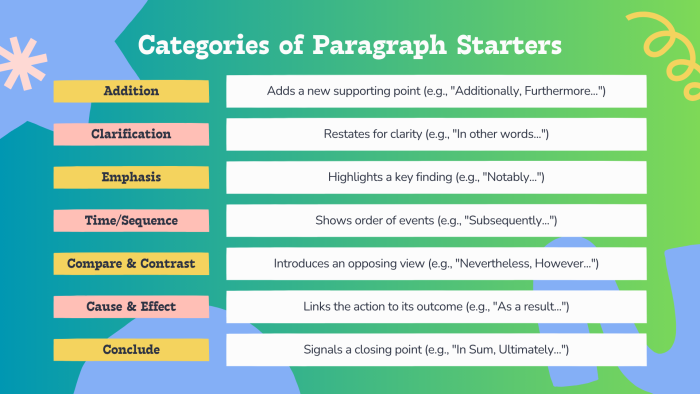
Paragraph starters generally fall into a small number of functional categories within academic nursing writing. Each category serves a distinct purpose depending on what the paragraph needs to accomplish for the reader. The table below summarizes these categories along with their core purpose in a nursing essay.
Category | Purpose | Example Starter |
Addition | Adds a new supporting point | Furthermore |
Contrast | Introduces an opposing view | However |
Cause and Effect | Links action to outcome | As a result |
Emphasis | Highlights a key finding | Notably |
Sequence | Shows order of events | Subsequently |
Clarification | Restates for clarity | In other words |
Conclusion | Signals a closing point | Ultimately |
Notice that no single category works for every paragraph across a nursing essay or research paper. Strong writers move between categories deliberately, matching each starter to the paragraph's actual argumentative job. This flexibility separates confident academic writing from essays that rely on the same phrase repeatedly.
60 Words to Start a Paragraph With
Below is a categorized list of sixty words and phrases nursing students can use to begin strong paragraphs. Each list stays short and practical, so you can scan it quickly while drafting or revising an essay. Pick the word that matches your paragraph's actual function rather than picking one at random.
Addition starters:
Additionally
Furthermore
Moreover
In addition
Similarly
Likewise
Equally important
Alongside this
Building on this
Contrast starters:
However
Conversely
On the other hand
Despite this
Nevertheless
Yet
In contrast
Although this is true
Even so
Cause and effect starters:
As a result
Consequently
Therefore
Because of this
This leads to
Due to this factor
Accordingly
Thus
Emphasis starters:
Notably
Importantly
Significantly
Above all
Most critically
In particular
It is worth noting
Remarkably
Sequence starters:
First
Next
Subsequently
Following this
Afterward
Eventually
Once this occurs
At this stage
Clarification starters:
In other words
To clarify
Specifically
That is to say
Put simply
More precisely
Evidence-based starters:
Research indicates
Clinical evidence shows
Studies consistently reveal
According to recent findings
Data collected from patients suggests
Nursing literature confirms
Conclusion starters:
Ultimately
In summary
Overall
Taken together
Given this evidence
Considering these factors
Example Paragraph Using a Strong Starter
Seeing a paragraph starter used correctly helps students understand how these words function inside real nursing content. Consider a paragraph discussing medication errors among newly licensed nurses working night shifts in hospitals. Notice how the starter connects this paragraph directly to the idea before it.
Fatigue significantly increases the likelihood of medication errors among nurses working extended night shifts. Consequently, hospitals have begun adjusting scheduling policies to limit consecutive overnight assignments for new staff. This shift toward safer scheduling reflects a broader industry effort to protect both patients and nursing professionals.
Here, "Consequently" signals a direct cause and effect relationship between fatigue and hospital policy changes. The paragraph stays focused, moves logically, and never leaves the reader guessing about the connection. This same structure works across nearly any nursing topic, from ethics essays to case study analysis.
Try swapping "Consequently" for "However" and notice how the entire meaning of the paragraph shifts immediately. Suddenly the sentence would suggest hospitals resisted changing schedules despite clear evidence of fatigue-related risk. This small exercise shows exactly why picking the right starter changes how readers interpret your argument.
Common Mistakes Students Make With Starters
Even strong writers fall into predictable traps when choosing how to open a paragraph in nursing essays. Recognizing these patterns early makes it much easier to correct them during the revision process. The table below highlights common mistakes alongside quick fixes any nursing student can apply immediately.
Common Mistake | Why It Weakens the Essay | Quick Fix |
Overusing "Also" | Sounds repetitive and informal | Rotate varied addition words |
Starting with "This" alone | Creates vague, unclear reference | Name the specific idea |
Skipping transitions entirely | Leaves readers guessing | Add a functional starter |
Repeating the same word | Feels monotonous throughout | Track word usage while drafting |
Choosing a misleading starter | Confuses paragraph's true purpose | Match starter to actual logic |
Overloading with long phrases | Buries the paragraph's main point | Prefer shorter, direct transitions |
Tips for Picking the Best Starter
Choosing the right paragraph starter takes practice, but a few guiding principles make the process much easier. These tips apply whether you are writing a short reflection paper or a lengthy capstone project. Skim the list below and apply whichever tips match your current writing habits.
Match the starter to the paragraph's actual logical function
Avoid repeating the same starter more than twice per essay
Read the sentence aloud to check if it sounds natural
Choose formal academic language over casual conversational phrases
Vary starter length so some paragraphs open with single words
Never force a transition word where none is logically needed
Keep starters short so they do not overwhelm the sentence
Review each paragraph's first line during your final edit
Build a personal list of favorite starters by category
Study transitions used in published nursing journal articles
Avoid three consecutive paragraphs from the same category
Ask a peer if paragraph connections feel logical aloud
These tips work best when applied gradually rather than all at once during a single revision session. Trying to fix every paragraph starter in one sitting often leads to rushed, mechanical choices instead of thoughtful ones. Focus on two or three tips per essay until each becomes a natural part of your writing process.
Reading your work aloud remains one of the fastest ways to catch awkward or forced transitions. Your ear often notices problems that your eyes skip past during silent, familiar readings of your own draft. If a starter feels clunky when spoken, it likely needs revision before your final submission.
Tracking repeated starters becomes easier once you highlight the first word of every paragraph in your draft. This visual method quickly reveals patterns, such as overusing "additionally" or relying too heavily on one category. Once identified, these repeated words are simple to replace with alternatives from a different functional group.
Besides, treat this list as a living resource rather than a fixed, one-time reference. Add new starters as you encounter them in textbooks, journal articles, and peer-reviewed nursing research. Over time, your personal collection will grow far beyond these twelve starting points.
How to Practice This Skill Effectively
Reading about paragraph starters helps, but real improvement only comes through repeated, deliberate practice over time. Try rewriting three paragraphs from an old essay using a different starter category for each one. Compare the revised version against your original draft to notice the improvement in flow.
Another effective method involves collecting strong starters while reading published nursing journal articles closely. Keep a running document of phrases you notice, sorted into the categories covered earlier in this guide. Over several weeks, this personal reference list becomes a fast, reliable tool during timed essay writing.
Peer review also strengthens this skill faster than editing alone, since fresh eyes catch missed connections. Ask a classmate to underline every paragraph starter in your draft before you submit any assignment. Discuss together whether each starter accurately reflects the logical relationship between the surrounding paragraphs.
Emerging Trends in Nursing Academic Writing
Nursing education is shifting quickly as digital tools and evidence-based practice reshape how students write. Many nursing programs now expect students to cite real-time clinical data alongside traditional peer-reviewed sources. This trend means paragraph starters increasingly need to introduce data-driven claims with precision and confidence.
Artificial intelligence writing assistants are also changing how students draft and revise nursing coursework today. While these tools can suggest transitions automatically, students still need to judge whether a suggestion fits their argument. Understanding paragraph starters manually protects students from over-relying on automated suggestions that may miss context.
Another emerging shift involves interprofessional writing, where nursing students write alongside pharmacy or medical peers. These collaborative papers demand extremely clear transitions since multiple disciplines are represented within a single document. Future nursing curricula will likely place even greater emphasis on transition clarity across mixed-discipline writing projects.
Telehealth documentation is also pushing nursing writing toward shorter, more direct paragraph structures than before. As virtual care expands, nurses must summarize patient encounters quickly using clear, well-organized written paragraphs. This real-world shift makes paragraph starter mastery more relevant to nursing careers than ever before.
Global health writing is another area where paragraph starters are gaining fresh importance among nursing students. Papers comparing healthcare systems across countries need precise contrast and comparison starters to stay accurate. As nursing programs expand global health coursework, this skill will likely become even more essential.
Looking further ahead, nursing writing may increasingly blend narrative case storytelling with traditional evidence-based structure. Paragraph starters will need to bridge these two styles without losing academic rigor or emotional clarity. Students who master flexible transitions now will likely adapt faster to whatever format nursing writing takes next.
Starters Across Different Nursing Assignments
Different nursing assignments call for slightly different paragraph starter choices depending on the writing purpose. Reflective essays often lean on emphasis or sequence starters to highlight personal clinical growth over time. Research papers, by contrast, rely more heavily on evidence-based starters that introduce data and citations.
Care plan write-ups typically favor cause-and-effect starters, since these documents track actions and patient outcomes closely. A sentence like "As a result, the care plan was adjusted" fits naturally within this format. Clarity here directly affects patient safety, so vague or missing transitions carry real consequences.
Case study analyses often mix categories, moving between evidence, contrast, and conclusion starters within a single paper. A strong case study might introduce data with "research indicates," challenge it with "however," and close with "ultimately." Recognizing which assignment type you are writing helps you select starters more intentionally.
Discussion board posts and shorter reflection pieces usually need lighter, more conversational starters than formal papers. Even so, maintaining some structure with words like "importantly" or "in addition" keeps posts organized. This flexibility shows that paragraph starters scale naturally across nearly every nursing writing format.
Frequently Asked Questions (FAQs)
What are paragraph starters for argumentative essays? Paragraph starters for argumentative essays often signal contrast, evidence, or emphasis to strengthen a claim. Words like "however" or "research indicates" help readers follow the writer's persuasive reasoning clearly.
How do you start a body paragraph sentence? A body paragraph should open with a word that connects directly to the previous paragraph's idea. Starters like "furthermore" or "as a result" work well depending on the paragraph's specific purpose.
What are good conclusion paragraph starters? Good conclusion starters include phrases like "ultimately," "in summary," or "taken together" to signal closure. These words tell readers that the essay is now moving toward its final synthesis of ideas.
What, how, and why paragraph sentence starters work best? "What" paragraphs often begin by defining a concept, while "how" paragraphs explain a clinical process. "Why" paragraphs typically open with cause-and-effect starters like "because of this" or "consequently."
How do you start a PEEL paragraph sentence? A PEEL paragraph usually opens with the point being made, often using words like "notably" or "importantly." This immediately signals to the reader which claim the following evidence will support.
Key Takeaways on Paragraph Starters
Mastering paragraph starters gives nursing students a practical tool for writing clearer, more persuasive academic essays. These small words carry real weight, guiding readers smoothly from one clinical idea to the next. With nursing homework support and consistent practice, any nursing student can turn choppy paragraphs into confident, professional academic writing.
Start small by revising just one assignment using the categories and examples covered throughout this guide. Notice which starters feel natural and which ones still require conscious effort during your drafting process. Over time, strong paragraph openings will become second nature across every nursing course you take.