

Building Competency among Emergency Department Nurses
Building Competency among Emergency Department Nurses Regarding Adults with Autism
Abstract
The Emergency Department (ED) is an unpredictable unit in healthcare facilities where nurses are exposed to both physical and emotional hazards. Many nurse professionals have, in the past, confessed to feeling ill-prepared to deal with patients with ASD following the communication and social interaction barriers. Experimental evidence clearly shows how unprepared ED nurses feel when they find themselves in a medical case that requires psychiatric intervention. Therefore, the purpose of this research is to recognize the pressing need for initiation of training programs to build the competence of nurses in the ED of Jackson Memorial Health facility when dealing with adult patients with autism. The focus is on adults aged between 25-65years, with level 2 ASD. The project entailed a qualitative review of articles and experiments on the issue of emergency care for ASD individuals. Through a qualitative analysis of articles, the researcher found out that the prevalence of autism-related accidents in the ED reduces with age, and falls were the most common. Rigorous training and careful implementation of approaches that focus on safe and quality emergency care for adults with ASD are the best ways to build the competence of nurses.
Background
ED is an unpredictable unit in hospitals where nurses make emergency response-planning efforts and get exposed to both physical and emotional hazards. Violence and agitation are characteristics that ED nurses are familiar with, mainly when dealing with impatient individuals with crippling injuries or illnesses. Research by McGonigle et al. (2014) pointed out that acute agitation in the ED creates diagnostic and treatment challenges. If Autism Spectrum Disorder (ASD) is added onto the picture, the situation becomes a recipe for an impending disaster. Many nurse professionals have, in the past confessed to feeling ill-prepared to deal with patients with ASD following the communication and social interaction barriers (Dunlap, 2018). Considering that patients with autism experience difficulties with socialization, they often interrupt the actions of nurses in a manner that may cause harm both to the caregiver and to themselves. In addition to aggression and agitation, patients with ASD can have Post-Traumatic Stress Disorder (PSTD) in the off chance the nurse fails provide care properly. All these events can be prevented by building the competence of nurses to implement patient centered-care with a specific focus on the needs of autistic individuals.
Problem Statement
The burden of the ED unit in the US is very high, both regarding the number of patients and the associated costs of care (Vohra, Madhavan & Sambamoorthi, 2016). The ED receives most of the critically ill patients visiting a health facility. Therefore, nurses in this department are trained to save lives by stabilizing the patients’ conditions. Their priority is on health assessment and treatment as opposed to communication and building a relationship with the patient due to the time constraints within which they operate (Dunlap, 2018). Such urgency and speed create a unique challenge when treating an adult with autism. Experimental evidence clearly shows how unprepared ED nurses feel when they find themselves in a medical case that requires psychiatric intervention. Despite the increasing numbers of patients with ASD, many nurses are often unsure of how best to meet the healthcare needs of this unique population (Opar, 2018). As a result, problems arise not only regarding the quality but also the safety of care provided.
Purpose
The purpose of this research is to recognize the pressing need for initiation of training programs to build the competence of nurses in the ED of Jackson Memorial Health facility when dealing with adult patients with autism. Just like everybody else, people with disorders have an equal right to access high standards of healthcare (Appelgren, Bahtsevani, Persson & Borglin, 2018). For this reason, this research aims to identify and figure out ways to address the unmet health needs of people with autism. The target is autistic patients aged between 25-55years. However, the focus is on patients with level 2 ASD, which, according to the Diagnostic and Statistical Manual of Mental Disorders (DSM-5), characterizes an individual who has challenges with both nonverbal and verbal cues (Nicolaidis, Kripke & Raymaker, 2014). They are also individuals with difficulties in changing focus as well as a limited ability to cope with social interactions (Dunlap, 2018). A further objective is to figure out the training programs already implemented, if any, and to gauge their effectiveness and cost-efficiency. Overall, there are several challenges that nurses face in the attempt to provide patients with autism with the best emergency care; hence, the purpose of this project is to alleviate these problems through training and implementation of better practices.
Method(s)
The project entailed a qualitative review of articles and experiments on the issue of emergency care for ASD individuals. There was no experimentation as the researcher capitalized on secondary sources of information. The sources were all within five years and were obtained from reputable websites and credible journals. The terms to look out for included ‘autism,’ ‘autistic,’ ‘ASD,’ ‘emergency care’ and ‘nursing.’ The researcher also narrowed down the literature to include in the project using the age of the target population and the hospital department from which the findings were obtained. The sources were analyzed individually, and any relevant information was extracted. The researcher sought an aggregate account of results from previous studies about the experiences of ED nurses and what could be done to build their competence, particularly regarding caring for autistic adults.
Results
Through a qualitative analysis of articles, the researcher found out that the prevalence of autism-related accidents in the ED reduces with age (Feil, Wallace, & Venkat, 2014). However, while the 20-29 age group reports more cases, the accidents among the over 60years adults with autism are often more fatal following their general body weakness and overall susceptibility to ill health. Therefore, appropriate emergency care is necessary across all age groups.
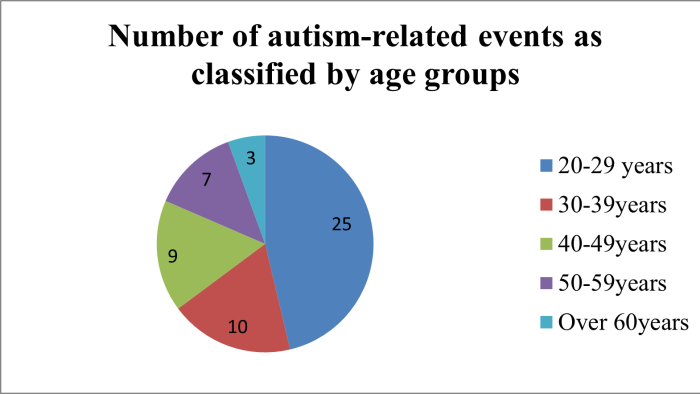
Nevertheless, the most common events were falls and errors associated with complications and incorrect procedures.
Related Reading
Break-Down of Autism-Related Cases Per Event Type
EVENT TYPE | PERCENTAGE FREQUENCY OF OCCURENCE |
Other | 26.8% |
Fall | 25.4% |
Error-related | 17.4% |
Complication-related | 14.5% |
Skin integrity | 11.6% |
Medication error | 3.6% |
Equipment, supply or device | 0.7% |
Building the competence of ED nurses taking care of adults with autism goes beyond stabilizing their conditions as it also entails helping them manage underlying problems. Autistic adults often have extensive co-morbidities like depression, substance dependence disorder, and anxiety (Vohra, Madhavan & Sambamoorthi, 2016). These create even more significant challenges for nurses; hence, there is a need for prompt management. Unfortunately, the reviewed literature suggests that a considerable majority of ED nurses have very little knowledge of the suitable therapies for ASD adults (Feil, Wallace, & Venkat, 2014). Such a realization heightened the need to take prompt action to prevent further harm.
Recommendations
Firstly, all ED nurses should be well-conversant with care approaches for individuals with autism. Such is because they do not know when they will need the expertise; hence, being prepared is imperative to avoid unfavorable outcomes (Saqr et al., 2018). They should also be trained on how to manage the co-morbidities associated with ASD to ease the job of caring for autistic patients. Moreover, clarifying the treatment guidelines for ASD adults in the ED is also essential as it reduces the risk of the patients following delayed or foregone care (Vohra, Madhavan & Sambamoorthi, 2016). Nurses ought to be sure of the approach to take since confusions are likely to create problems. Execution of risk reduction strategies can also go a long way in improving the safety of emergency services by preventing eventualities such as self-injury (Feil, Wallace, & Venkat, 2014). All in all, rigorous training and careful implementation of approaches that focus on safe and quality emergency care for adults with ASD are the best ways to build the competence of nurses.
Conclusion
Although emergencies affect all individuals equally due to the associated injuries and trauma, people with autism have a harder time recovering due to the additional health problems they face. Additionally, ED nurses are often ill-prepared regarding care for autistic adults. Therefore, there is a need for education to enhance the understanding of nurses in the ED on how best to care for autistic adults.
References
Appelgren, M., Bahtsevani, C., Persson, K., & Borglin, G. (2018). Nurses’ experiences of caring for patients with intellectual developmental disorders: a systematic review using a meta-ethnographic approach. BMC nursing, 17(1), 1-19. https://doi.org/10.1186/s12912-018-0316-9
Dunlap, J. J. (2018). Interacting with individuals on the autism spectrum. Retrieved from https://www.americannursetoday.com/interact-autism-spectrum/
Feil, M., Wallace, S. C., & Venkat, A. (2014). Improving care for patients with autism spectrum disorder in the acute care setting. Pennsylvania Patient Safety Advisory, 11(4), 141-148.
McGonigle, J. J., Venkat, A., Beresford, C., Campbell, T. P., & Gabriels, R. L. (2014). Management of agitation in individuals with autism spectrum disorders in the emergency department. Child and Adolescent Psychiatric Clinics, 23(1), 83-95. http://dx.doi.org/10.1016/j.chc.2013.08.003
Nicolaidis, C., Kripke, C. C., & Raymaker, D. (2014). Primary care for adults on the autism spectrum. Medical Clinics, 98(5), 1169-1191. https://doi.org/10.1016/j.mcna.2014.06.011
Opar, A. (2018). The troubling ways autistic adults are being let down by the healthcare system. Retrieved from https://www.independent.co.uk/news/health/autistic-adults-healthcare-system-health-spectrum-hospital-a8484341.html.
Saqr, Y., Braun, E., Porter, K., Barnette, D., & Hanks, C. (2018). Addressing medical needs of adolescents and adults with autism spectrum disorders in a primary care setting. Autism, 22(1), 51-61. https://dx.doi.org/10.1177%2F1362361317709970
Vohra, R., Madhavan, S., & Sambamoorthi, U. (2016). Emergency department use among adults with autism spectrum disorders (ASD). Journal of Autism and Developmental Disorders, 46(4), 1441-1454. doi:10.1007/s10803-015-2692-2.